

Workflow
How do I use terraPen?
Every step from unboxing to your first finished plot now lives in one place: the terraPen Documentation. This page is the quick version — how to get from artwork to a finished plot, and which software to use to get there.
Quick start
terraPen uses gcode to tell the machine what to plot. Use a program to convert a bitmap image or vector into gcode, or generate gcode directly from a generative program — the choice is yours, and a few options are below. Once you have a gcode file, upload it to terraPen through the web interface, position your pen and paper, zero the pen position, and press start.
To plot live from a generative program, you can stream gcode directly to the machine over USB. Streaming setups vary a lot by software, so we can't support every combination — but any of the gcode flavours below will produce a good plot.
Turning artwork into gcode
terraForge — our own software, recommended
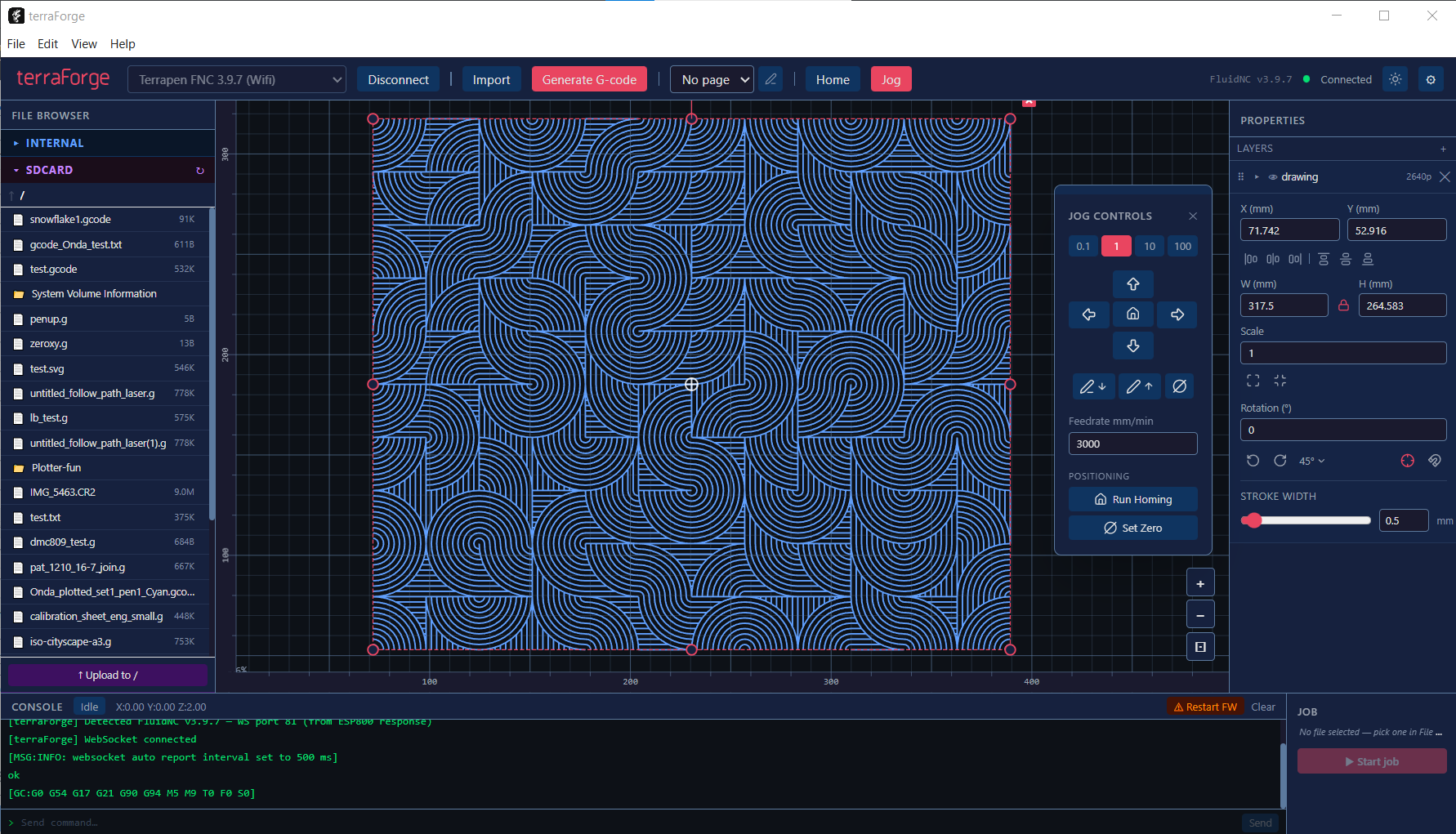
terraForge is our own free, open-source G-code app, built specifically for terraPen: import SVG or PDF, position it on the bed, and generate optimised G-code, then connect over Wi-Fi or USB for live control. Read more on the blog.
Download terraForge v1.4.0
Free and open source · Windows, macOS & Linux
PlotterFun

A simple but powerful web app that translates images to vectors, with several filters and configurable renderers.
DrawingBotV3

An open-source program, with a paid tier, that converts images into SVGs, PDFs and gcode using a variety of configurable renderers.
LightBurn

A commercial laser cutter and engraver package. It's built for lasers, not plotters, but its gcode output works well on terraPen.
vpype

An open-source Python tool that converts SVGs directly into gcode from the command line.
Controlling terraPen
Web interface

The simplest way to get started: connect directly to terraPen over Wi-Fi and upload your gcode file to the plotter. From here you can home, zero the pen position, and start the plot.
When you first power on terraPen, it starts a Wi-Fi access point named terraPen (password: 12345678). Once connected, your device* should open the web interface automatically, or you can go directly to http://terrapen.local. From there you can also enter your home network's details so the plotter joins it, and reach http://terrapen.local without reconnecting to the plotter's own network each time.
* Windows and Android. Apple devices will open the page but won't let you interact with it — close that window and open terrapen.local manually in a browser instead.
Full documentation
Every step in more detail — unboxing, your first plot, YAML config reference, FAQs, and support for older machines — lives at the terraPen Documentation site. That's the place to go if you get stuck.
